Tech & Meet
The 5 Levels of Infrastructure as Code
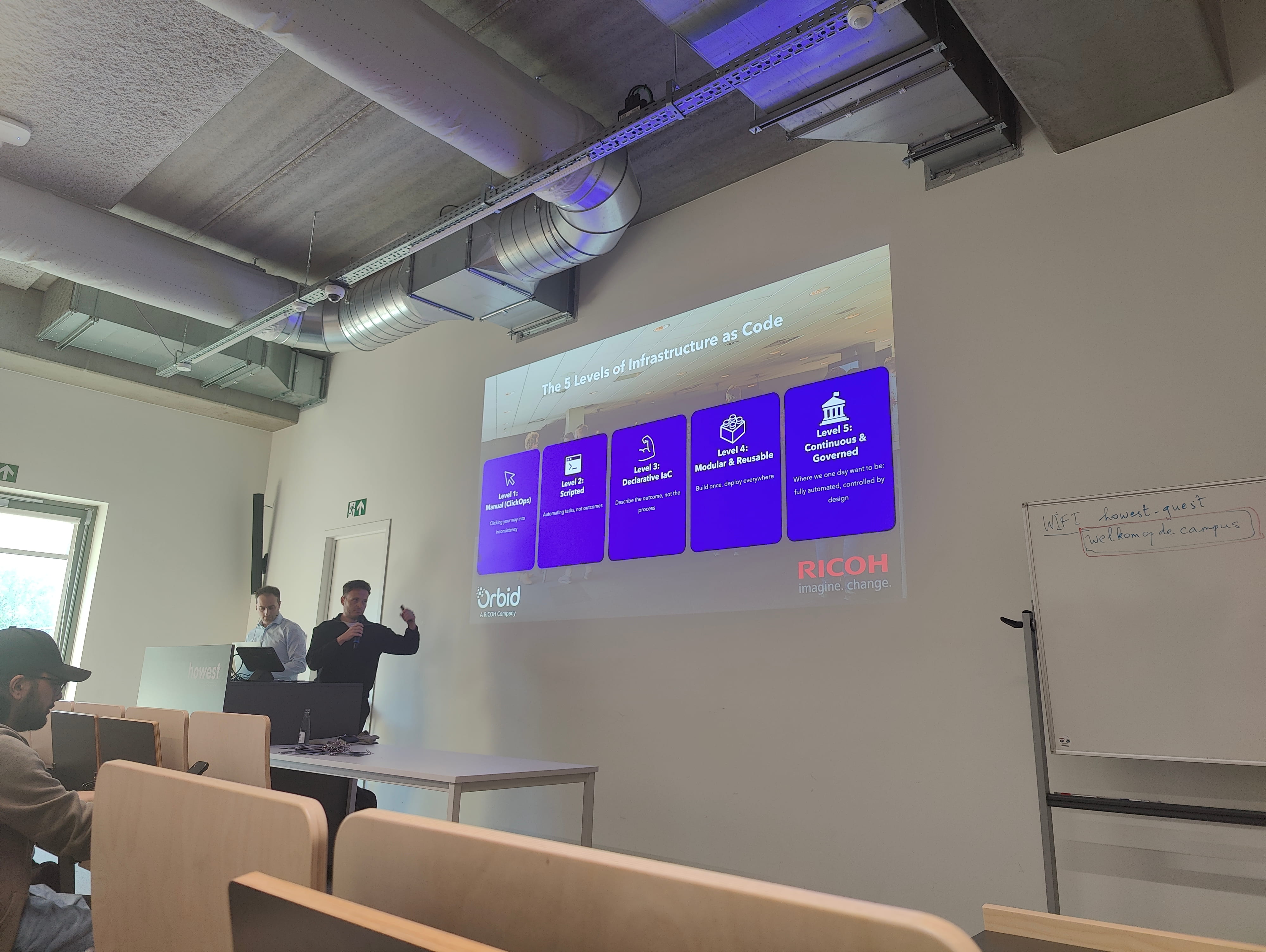
I attended a Tech&Meet session titled The 5 Levels of Infrastructure as Code by Tim Van Roosbroeck and Dimitry Decan from Orbid. The presentation focused on the evolution of Infrastructure as Code (IaC) practices and how organizations can gradually move from manual infrastructure management towards more automated and governed environments.
The session introduced a maturity roadmap consisting of five different levels: 1. Manual (ClickOps) 2. Scripted 3. Declarative IaC 4. Modular & Reusable 5. Continuous & Governed
What I found interesting about this structure was that it clearly showed how Infrastructure as Code is not simply a single tool or technology, but rather an evolution in the way infrastructure is managed and deployed.
The presentation discussed how many environments still rely heavily on manual configuration, often referred to as “ClickOps”, where systems are configured directly through graphical interfaces. While this may work for smaller environments, it becomes increasingly difficult to maintain consistency, scalability, and reproducibility as systems grow larger and more complex.
From there, the session explored how scripting and declarative Infrastructure as Code approaches help standardize deployments and reduce manual work. Technologies such as Bicep were presented as tools that simplify Azure infrastructure management while improving readability and maintainability.
Another important theme was the transition from isolated deployment scripts towards reusable and governed infrastructure. The speakers explained how modularity, automation, and policy-driven deployments become increasingly important in larger cloud environments. Infrastructure management is no longer only about deploying resources, but also about maintaining consistency, governance, and scalability over time.
Throughout the session, several examples were demonstrated within Azure environments, which helped connect the theoretical concepts to practical use cases. Seeing how infrastructure definitions and deployments can be structured in a reusable way gave a clearer picture of how modern cloud environments are managed in practice.
Overall, I found the session to be a useful introduction to the broader maturity journey behind Infrastructure as Code. It highlighted how automation is not just about convenience, but also about improving reliability, consistency, and long-term maintainability within modern cloud infrastructures.